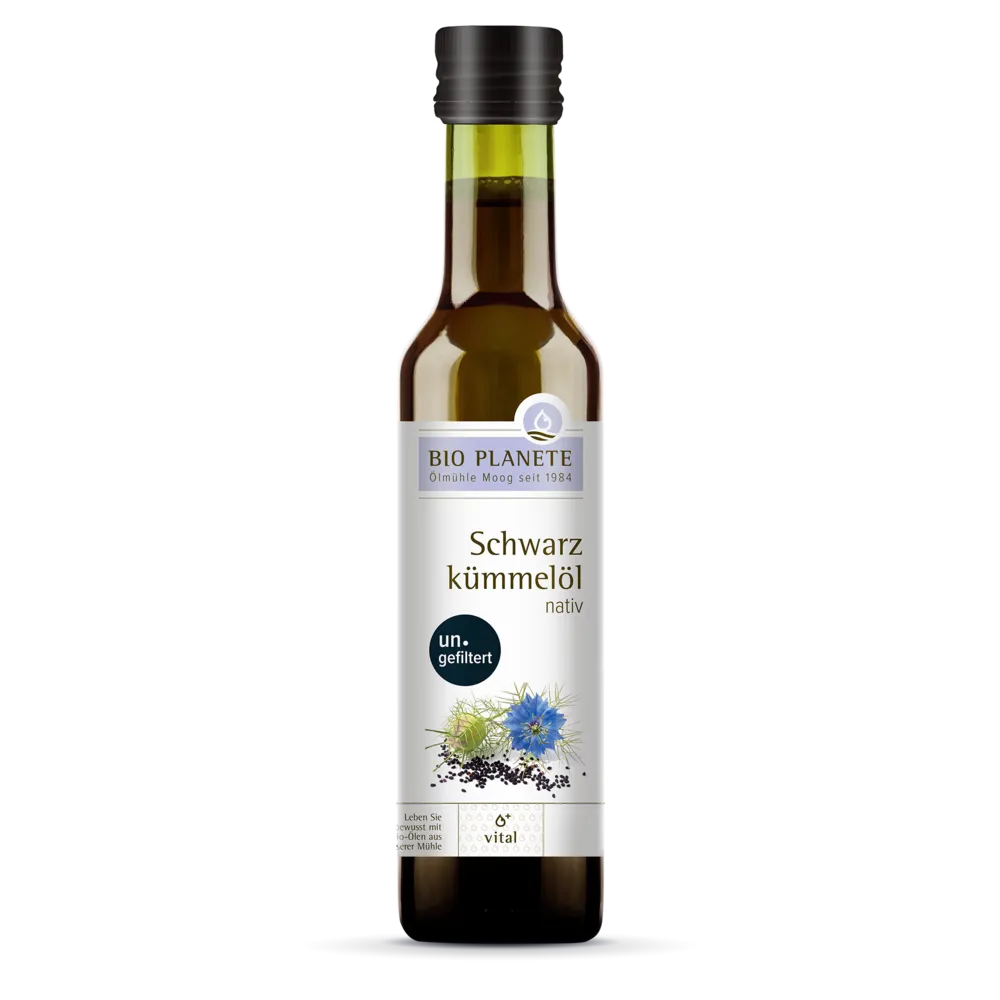
Black Cumin Oil
· Virgin ·
100 ml
250 ml
Unfiltered black cumin oil is black cumin oil in its purest form: intensely aromatic, spicy and natural – perfect for taking it neat. We recommend enjoying 2 teaspoons per day.
The oil is obtained from the precious seeds of Nigella sativa, cold-pressed and left unfiltered, which preserves the characteristic natural particles. Its intense aroma is due to the secondary plant compound thymoquinone.
Thymoquinone is found in the essential oils of black cumin and has been investigated in numerous scientific studies with regard to its anti-inflammatory, blood pressure-lowering and immune-supporting properties, as well as its potential to help with allergies and asthma. Our virgin oils contain up to 250 mg of thymoquinone per 100 ml.
Black cumin oil is also rich in polyunsaturated fatty acids. Replacing saturated fats with polyunsaturated fatty acids in the diet helps maintain normal blood cholesterol levels. A varied, balanced diet and a healthy lifestyle are important.
Our black cumin oils come from certified organic farming in Egypt, where the seeds develop their full strength under the intense sun. Black cumin has been valued in the Orient for around 3,500 years and is rightly known as the “gold of the pharaohs”. The plant is not related to caraway or cumin, however – its seeds differ clearly in shape, taste and aroma.
Product of organic farming
** For this product, the raw materials may in some cases originate from other countries. This especially holds true in cases of crop shortfall, or when batches of raw goods do not meet our quality requirements. In any event, the raw material are being tested by BIO PLANÈTE and are in 100% compliance with our strict organic quality requirements. The respective origin is always noted on the product label.
Average nutritional analysis for 100 ml
** % of daily reference intake (adults)
The consumption of black cumin oil during pregnancy should be avoided due to its high essential oil content.
Black Cumin Unfiltered Oil
· Virgin ·
250 ml
Unfiltered black cumin oil is black cumin oil in its purest form: intensely aromatic, spicy and natural – perfect for taking it neat. We recommend enjoying 2 teaspoons per day.
The oil is obtained from the precious seeds of Nigella sativa, cold-pressed and left unfiltered, which preserves the characteristic natural particles. Its intense aroma is due to the secondary plant compound thymoquinone.
Thymoquinone is found in the essential oils of black cumin and has been investigated in numerous scientific studies with regard to its anti-inflammatory, blood pressure-lowering and immune-supporting properties, as well as its potential to help with allergies and asthma. Our virgin oils contain up to 250 mg of thymoquinone per 100 ml.
Black cumin oil is also rich in polyunsaturated fatty acids. Replacing saturated fats with polyunsaturated fatty acids in the diet helps maintain normal blood cholesterol levels. A varied, balanced diet and a healthy lifestyle are important.
Our black cumin oils come from certified organic farming in Egypt, where the seeds develop their full strength under the intense sun. Black cumin has been valued in the Orient for around 3,500 years and is rightly known as the “gold of the pharaohs”. The plant is not related to caraway or cumin, however – its seeds differ clearly in shape, taste and aroma.
| Ingredients | Organic black cumin oil, virgin, unfiltered* |
|---|---|
| Origin |
Egyptian agriculture / non-EU agriculture** Changing countries of origin possible. |
| Dietary information | Suitable for vegetarians, vegans and raw-food diets. |
| Allergy information | Produced in a facility that also processes peanuts, sesame, almonds, hazelnuts and walnuts. |
| Storage information |
Store at room temperature and protect from light. After opening, keep refrigerated and consume within 3 months. |
| Heatability | Do not heat. |
* From certified organic farming.
** For this product, the raw material may in some cases also come from
additional countries – for example in the event of crop failures, or if
batches do not meet our high quality standards. In all cases, the raw
materials are checked by BIO PLANÈTE and fully comply with our strict
organic criteria. The specific country of origin is always stated on the
product label.
Average nutritional values per 100 ml:
| Energy | 3373 kJ (820 kcal) |
|---|---|
| Fat | 90 g |
| of which saturates | 13 g |
| of which mono-unsaturated fatty acids | 22 g |
| of which polyunsaturated fatty acids | 55 g |
| Carbohydrates | 1.7 g |
| of which sugars | 0 g |
| Protein | 0.8 g |
| Salt | 0.01 g |
-
Why are unsaturated acids healthier than saturated fatty acids?
This is true primarily for all polyunsaturated acids, meaning omega 3 and omega 6 fatty acids. These occur more rarely in foods than mono-unsaturated and saturated fatty acids. In addition, the human body cannot make these fatty acids itself, so it depends on a sufficient intake of omega 3 and omega 6 acids from food. They have several important functions in the body, form part of cell membranes and contribute to preserving normal cholesterol levels, blood pressure and a normal cardiac function.
-
What is the difference between omega 3 and omega 6 acids?
The difference lies in the chemical structure of the molecules. Both classes of fatty acids are essential for humans, meaning our bodies cannot product them and depend on a sufficient intake from food. Nutritional sources of omega 3 fatty acids are exclusively marine algae, fish and plant oils and seeds. Unfortunately, we tend to take in far too little of these important fatty acids. Our daily nutrition gives us a ratio of omega 6 fatty acids to omega 3 fatty acids of approx. 15:1. The German Nutritional Association recommends a ratio of 5:1.
For example, the BIO PLANÈTE Salad Oil provides this optimal ratio of omega 6 to omega 3 fatty acids. If you want to balance out your omega-ratio with oils rich in omega 3, you can e.g. revert to Flaxseed Oil or our Omega Colour Oils. -
Where does the polyunsaturated fatty acid omega 3 occur?
Omega 3 fatty acids occur in plant seeds and plant oils as well as is saltwater fish and marine algae. Therefore, the German Nutritional Association recommends eating fish twice a week in order to supply the body with sufficient omega 3 fatty acids. Flaxseed Oil, Hempseed Oil, Camelina Oil and the BIO PLANÈTE Omega Colour Flaxseed mixtures have an especially high proportion of omega 3.
Omega 6 fatty acids are much more common: these fatty acids are also found in animal fats. That's why our daily nutrition contains more omega 6 fatty acids than omega 3 fatty acids, with the ratio being approx. 15:1. The German Nutritional Association recommends a ratio of 5:1. The BIO PLANÈTE Salad Oil provides this optimal ratio of omega 6 to omega 3 fatty acids. -
How can vegans meet their requirement of omega 3?
If you follow a vegan diet, dislike the taste of fish or cannot eat fish regularly (2x per week) for other reasons, you should make sure to keep a high-quality plant oil rich in omega 3 fatty acids in your fridge and use this to cover your requirement of these essential fatty acids. Flaxseed Oil, Hempseed Oil, Camelina Oil and the BIO PLANÈTE Omega Colour Flaxseed Oil Mixtures are particularly suitable for this. The latter have not just a high omega 3 content but also contain select ingredients which add to the taste.
-
Why should you not heat oils with polyunsaturated fatty acids?
The more polyunsaturated fatty acids are contained in the oil, the more susceptible it is to environmental influences such as heat, UV light and oxygen. If such oils are heated up too much or for too long, this can result in a damaging decomposition and in conversion products such as trans-fatty acids. As a result, e.g. our Flaxseed Oil and other Vital Oils are filled into light-protected bottles in a protective atmosphere (free from oxygen). These oils should be stored in the fridge after opening.
-
What is alpha-linolenic acid and where does it occur?
Alpha-linolenic acid is a triple unsaturated essential fatty acid and – like DHA – belongs to the group of omega 3 fatty acids. If 2g are taken daily, alpha-linolenic acid contributes to the preservation of normal blood cholesterol levels.
Flaxseed Oil, Camelina Oil, Rapeseed Oil, Hempseed Oil and Walnut Oil have an especially high alpha-linolenic acid content. -
Why is Black Cumin Oil so popular? What is its effect?
Black Cumin Oil has a high polyunsaturated fatty acid content. Replacing saturated fatty acids with polyunsaturated fatty acids in nutrition contributes to the preservation of normal blood cholesterol levels. Black Cumin Oil also has a high proportion of essential oil. Many consumers therefore also give it to their dogs as an effective internal and external protection against ticks.
-
Can I consume Black Cumin Oil during pregnancy?
We do not recommend pregnant women to consume this oil due to its high essential oil content.
-
Why can Black Cumin Oil sometimes be cloudy, flaky or even solid?
Some of the fatty acids solidify at low temperatures (e.g. when stored in the fridge) while most of the oil remains liquid. These fat crystal are visible as particles and can make the oil look cloudy. Since the oil is completely untreated, it contains fatty by-products which serve as crystallisation cores. This means that natural oils more easily become cloudy than refined oils. The cloudiness is harmless and reverts again if you heat up the oil briefly (e.g. in a water bath or on your radiator).
-
What conditions and standards are behind the organic seal on our oils?
An organic seal is a quality and test seal with which products from organic farming are marked. In 2010, a binding new organic seal was introduced throughout the EU, also known as the EU organic logo, which identifies food from organic farming (a star-shaped leaf on a green background).
This seal replaced the German state organic seal (green hexagon with "BIO" lettering), which had existed since 2001, with the same standards in terms of content. Due to the high degree of popularity of its predecessor, both seals are still often used today.
The use of this certification is strictly regulated by the publisher and is subject to ecological requirements. Compliance with the criteria by producers is ensured by a documentation obligation as well as regular sampling and examination of product samples. Compliance with the regulations is monitored in Europe by the responsible Eco-Control bodies.
Foods labelled with the organic seal must, among other things:
• Not be produced by or with/from genetically modified organisms
• Not to be produced with the use of synthetic pesticides
• Contain no more than 5% conventionally produced components (in exceptional cases, if ingredients are not available in ecological quality, in accordance with Annex VO)
• not contain sweeteners and stabilisers as well as synthetic colourants, preservatives and flavour enhancers
• not result from monotonous crop rotations (two-, three- and four-field farming)
• and much more: more information on the EU Organic Label -
Can I use the oil even after the expiration date?
We can no longer guarantee the oil's perfect quality after its best before date.
In the interest of sustainability, however, we would like to point out the following: vegetable oils do not belong to the group of very sensitive foodstuffs and can usually still be consumed after the best-before date. This is especially true if the bottle is still sealed and it has been stored away from heat sources. Therefore, we recommend using your senses to test the oil before disposing of it. Oil that has been stored for too long can be easily recognized by smell and taste. If it tastes rancid or unusual (off), it should not be consumed. -
How do I remove the labels from the jars and bottles?
Since we use oil-soluble glue for the labels, the best way to remove the label from the coconut jars is with oil. Simply coat the label with oil, let it absorb overnight and peel off easily in the morning. However, if the label is already off and only the glue is on it, this method doesn't work as well. In this context, we have been told of positive experiences with orange oil cleaner, such as from AlmaWin or Sodasan. Another option is a hair dryer - because heat also loosens the label well.
Get more suggestions at Upcycling & Creative.